
Americans feel poorer even as markets boom as economists warn of a dangerous ‘K-shaped economy’ divide
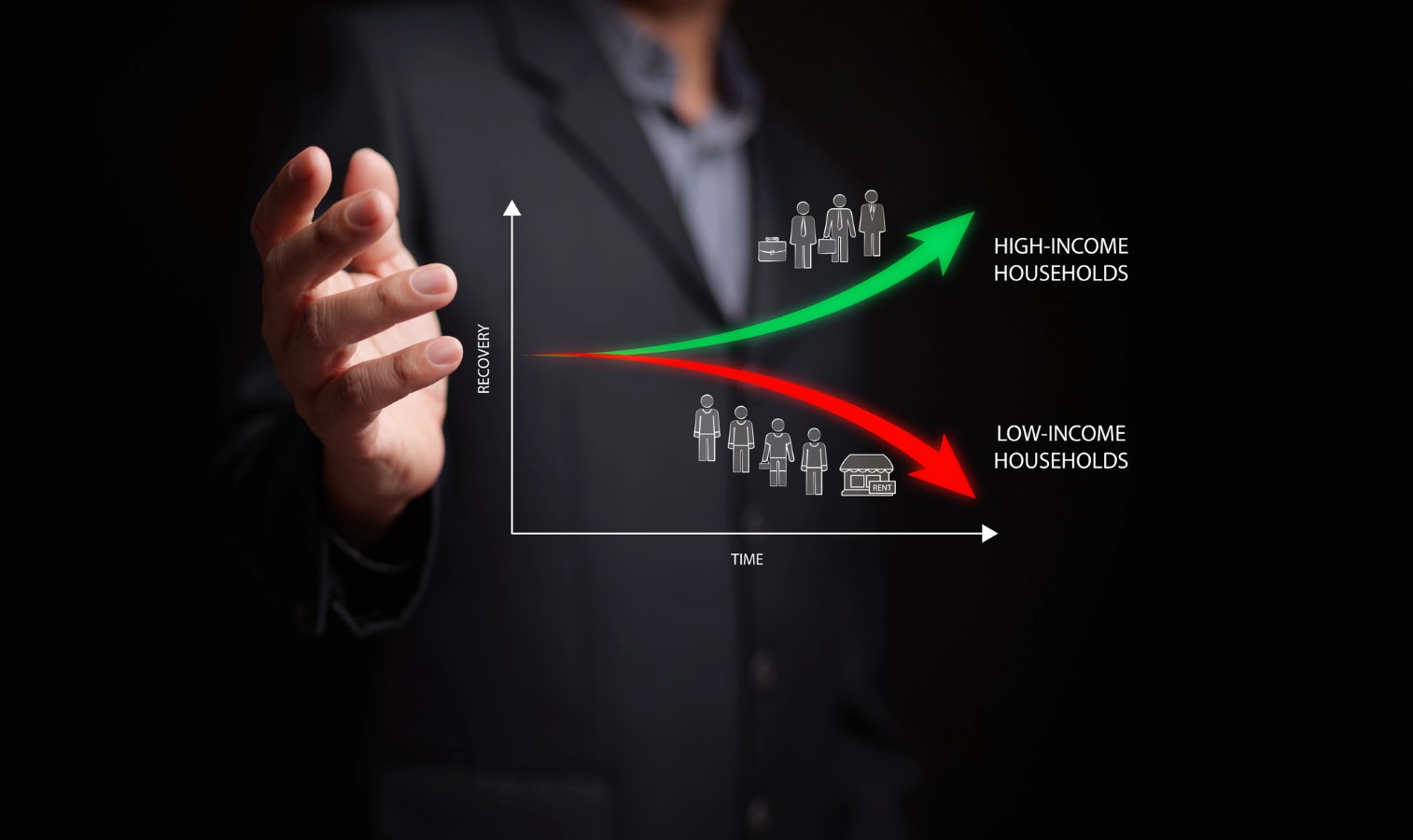
Economists increasingly agree that the U.S. economy is splitting into two diverging paths; one lifting higher-income households while the other drags down millions of lower- and middle-income earners. The idea of a K-shaped recovery has evolved into a defining theme of the mid-2020s economy.
The concept echoes a sentiment famously captured by some politicians: the rich get richer while the poor fall behind. Today, economists, policymakers, and Wall Street strategists say that dynamic is playing out in real time; reshaping consumer spending, financial security, and economic opportunity across the country.
A K-shaped economy describes a divergence in financial outcomes following a major shock; such as the the lockdown in 2020 where some groups recover quickly while others continue to struggle.
Instead of a broad, uniform rebound, the economy splits into two arms. The upward arm represents households benefiting from rising asset values, strong wages, and spending power. The downward arm reflects those facing stagnant income growth, higher living costs, and weaker job prospects.
This widening gap has become increasingly visible in spending patterns, wealth accumulation, and consumer sentiment.
A long-standing divide intensified after the lockdowns

According to Mark Zandi, chief economist at Moody’s Analytics, the roots of the divergence stretch back decades. He points to policy shifts beginning in the Reagan era that weakened labor’s share of national income while boosting capital returns.
“You really start to see this in the Reagan era,” Zandi said. “That’s when you get a structural divergence between productivity growth and median wage growth.”
Globalization, declining unionization, tax reforms, and the shift away from manufacturing all contributed to a trend in which wealth increasingly flowed to asset owners rather than wage earners.
Stock market gains fuel the top arm of the K
Record stock market rallies in recent years have disproportionately benefited wealthier households, who are more likely to hold financial assets. This surge has encouraged higher-income Americans to continue spending, sustaining overall consumer demand even as inflation pressures persist.
Research by Zandi found that in the second quarter of 2025, the top 10% of Americans accounted for roughly 49% of total consumer spending; an extraordinary concentration that highlights how dependent the economy has become on affluent households.
Lower-income consumers pull back on spending

While luxury spending remains resilient, companies serving lower-income customers are seeing a different reality. Fast-casual chains like Chipotle Mexican Grill and Cava; as well as fast-food giant McDonald’s; have reported that younger and lower-income consumers are cutting back, dining at home more frequently, and trading down on purchases.
These behavioral shifts illustrate how inflation and economic uncertainty are weighing more heavily on households with limited financial buffers.
Wealth concentration is reshaping consumption

At Morgan Stanley Wealth Management, chief investment officer Lisa Shalett has warned that income inequality is distorting economic signals.
“The income inequality stuff is really getting like completely wackadoo,” she said, citing data showing that the top 40% of households account for about 60% of spending while controlling nearly 85% of U.S. wealth.
She also noted that spending by wealthy households has been growing six to seven times faster than spending among lower-income groups; a dynamic that can mask underlying economic weakness.
The Federal Reserve acknowledges the split
Even policymakers are recognizing the divergence. During a Federal Open Market Committee meeting last December, Federal Reserve Chair Jerome Powell said consumer-facing companies are reporting belt-tightening among low- and moderate-income households.
“We hear about this a lot,” Powell said. “They’ll all say that we’re seeing people tightening their belts… buying less.”
This bifurcation complicates monetary policy, as aggregate data may suggest strength while large segments of the population struggle.
Economist Tyler Schipper notes that inflation driven by tariffs and supply disruptions tends to hurt lower-income households more. They spend a larger share of their budgets on essentials such as food, clothing, and transportation; categories often affected by import levies.
Analysis from the Yale Budget Lab found that tariffs can impact lower-income households more than three times as much as higher-income ones, further extending the lower arm of the K.
A cooling labor market deepens the divide

According to Claudia Sahm of New Century Advisors, a “low-fire, low-hire” labor market has reinforced the two-tiered economy.
While overall layoffs remain relatively modest, job opportunities for new entrants; particularly Gen Z workers; have become scarcer following a post-pandemic hiring boom and the rise of automation and AI.
Data from Challenger, Gray & Christmas showed U.S. employers cut more than 108,000 jobs in January 2026; the largest January reduction since 2009.
Interest rates and monetary tightening reinforce inequality

The Federal Reserve’s historic tightening cycle; 11 rate hikes between 2022 and 2024 helped curb inflation but also widened financial disparities. Wealthy households, bolstered by asset appreciation, were better positioned to absorb higher borrowing costs.
Meanwhile, renters and debt-laden households faced rising mortgage rates, shrinking credit availability, and lingering pandemic-era debts.
“Folks in the top third… are doing well, but the remaining two-thirds of Americans are struggling,” Zandi said.
Some six-figure earners are ‘on thin ice’

Even high earners are not immune to financial stress. A recent analysis by consulting firm Kearney found that nearly half of households earning between $160,000 and $700,000 may be overleveraged due to housing costs, debt burdens, and exposure to stock market volatility.
These consumers may appear affluent but are vulnerable to financial shocks; highlighting how the K-shaped economy creates winners and losers even within upper-income brackets.
Survey data from The Harris Poll suggests many high earners are quietly struggling. Among Americans earning $200,000 or more, 64% reported using rewards points for essentials, while 50% relied on buy-now-pay-later services for purchases under $100.
Even reports from Goldman Sachs indicate significant shares of workers earning over $300,000 say they live paycheck to paycheck; underscoring the role of lifestyle inflation in eroding financial stability.
How much income is needed for economic security?

Research from the Urban Institute estimates that a U.S. family with children needs about $145,000 annually to achieve economic security; enough to cover housing, healthcare, childcare, education, transportation, and savings.
About 49% of Americans fall below that threshold, suggesting that even many middle-class households may feel stuck financially. Economist Gregory Acs described the phenomenon as a “hamster wheel economy,” where families can pay bills but struggle to get ahead.
Why a K-shaped economy raises recession risks
Economists say a bifurcated economy does not guarantee a recession; but it does increase vulnerability.
When growth depends heavily on affluent consumers, any shock that hits financial markets or high-income employment can quickly ripple through the broader economy. Concentrated job growth in sectors like healthcare and hospitality also limits resilience.
“The K-shaped economy… is potentially a more vulnerable economy,” Sahm said.
Zandi argues that narrowing the gap will require policy changes beyond monetary tools. He suggests reducing tariffs, boosting productivity through education and workforce development, and ensuring that gains from AI are broadly shared.
“The Fed can’t fix the K-shaped economy,” he said. “The distributional effects are up to fiscal policy.”
Ultimately, economists say addressing structural inequality; not just cyclical downturns will determine whether the two arms of the K continue to drift apart in the years ahead.
Like Financial Freedom Countdown content? Be sure to follow us!
14 essential strategies to maximize your Social Security and avoid costly mistakes
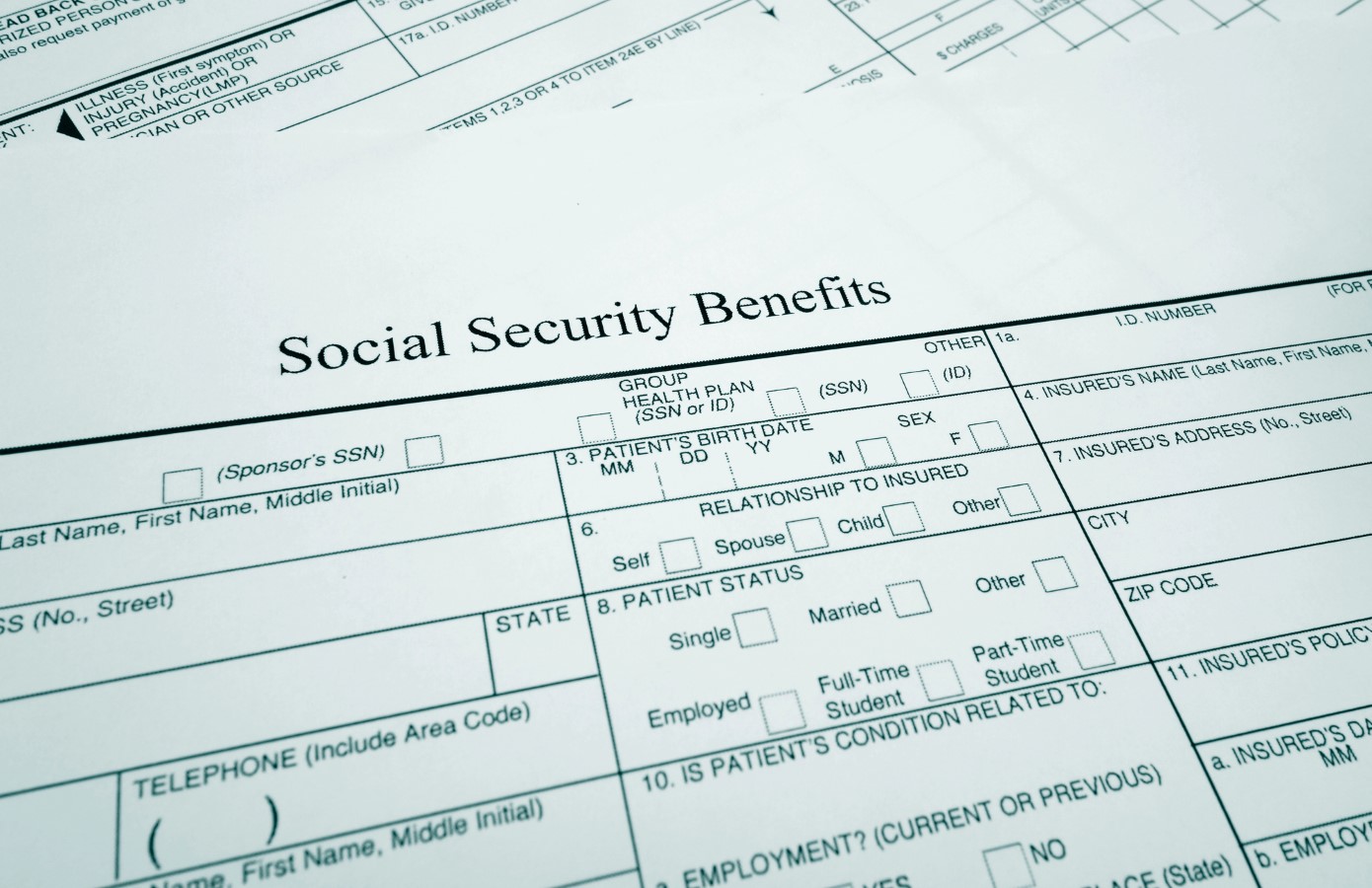
Social Security is a vital lifeline for many seniors, providing crucial income support during retirement. With inflation at its highest in four decades, Social Security’s inflation-adjusted benefits offer protection against rising costs.
Rising interest rates have disrupted many retirement portfolios, causing bond fund values to plummet. In this volatile financial landscape, Social Security can stabilize a typical stock-bond retirement portfolio. By implementing smart strategies, retirees can maximize their Social Security benefits and ensure a more secure financial future.
14 Essential Strategies to Maximize Your Social Security and Avoid Costly Mistakes
11 reasons you should claim Social Security early

Deciding when to claim Social Security is often about maximizing your benefit. Financial planners usually advise delaying your claim for as long as possible to secure the highest monthly payment. Your benefit is based on your lifetime earnings, with a full payout available at your full retirement age (FRA), which is currently between 66 and 67 depending on your birth year. Claiming before FRA results in a permanent reduction in your monthly benefit, while waiting beyond FRA leads to a permanent increase. However, the decision isn’t solely about maximizing the monthly check. Personal factors such as health, family circumstances, and financial needs can play a significant role in determining the right time to claim.
11 Reasons You Should Claim Social Security Early
Did you find this article helpful? We’d love to hear your thoughts! Leave a comment with the box on the left-hand side of the screen and share your thoughts.
Also, do you want to stay up-to-date on our latest content?
1. Follow us by clicking the [+ Follow] button above,
2. Give the article a Thumbs Up on the top-left side of the screen.
3. And lastly, if you think this information would benefit your friends and family, don’t hesitate to share it with them!

John Dealbreuin came from a third world country to the US with only $1,000 not knowing anyone; guided by an immigrant dream. In 12 years, he achieved his retirement number.
He started Financial Freedom Countdown to help everyone think differently about their financial challenges and live their best lives. John resides in the San Francisco Bay Area enjoying nature trails and weight training.
Here are his recommended tools
Personal Capital: This is a free tool John uses to track his net worth on a regular basis and as a retirement planner. It also alerts him wrt hidden fees and has a budget tracker included.
Platforms like Yieldstreet provide investment options in art, legal, real estate, structured notes, venture capital, etc. They also have fixed-income portfolios spread across multiple asset classes with a single investment with low minimums of $10,000.