California gas tax rises July 1 as Newsom faces backlash over higher prices and Republicans demand relief
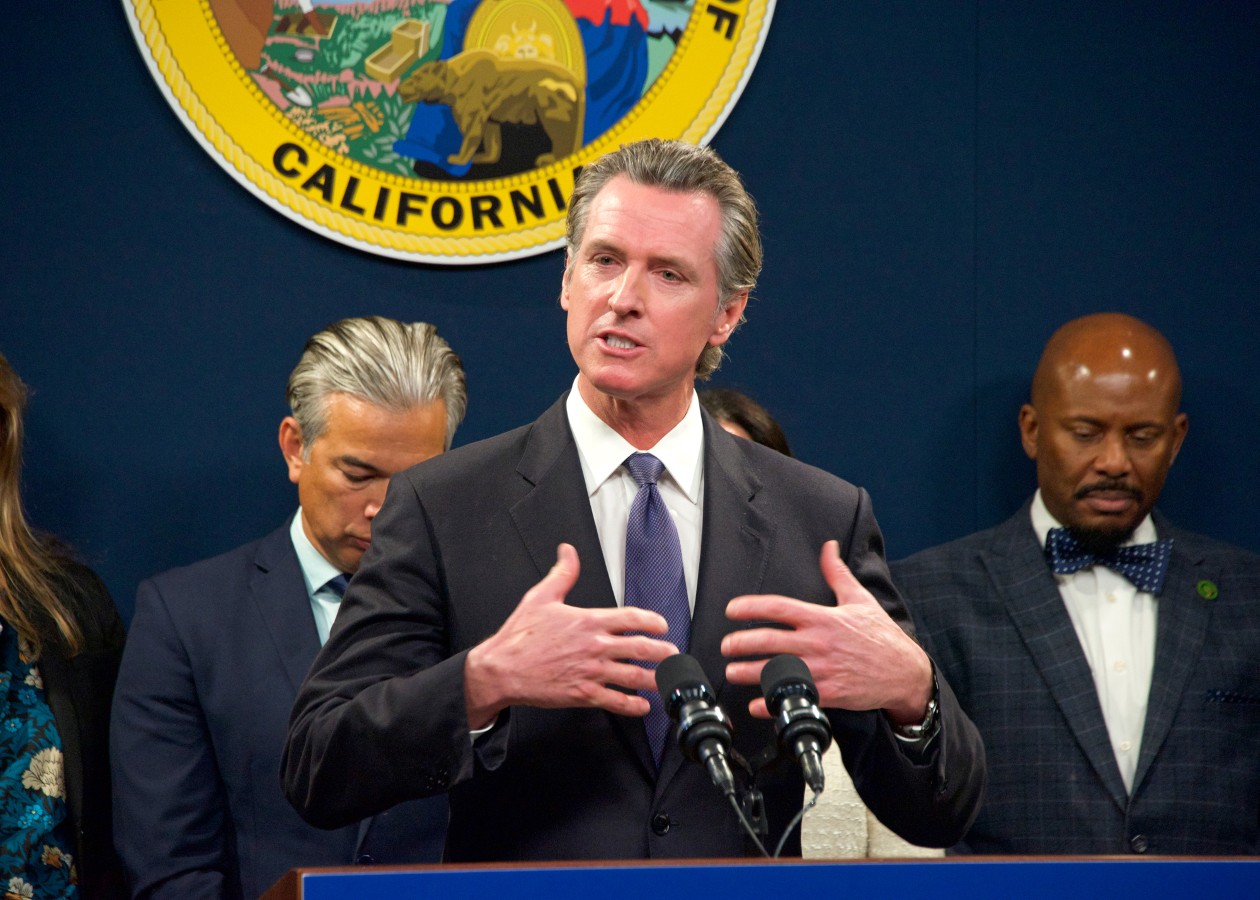
California drivers are paying more at the pump beginning July 1 after the state’s gasoline excise tax automatically increased by 2.2 cents per gallon. The adjustment raises the excise tax from 61.2 cents to 63.4 cents per gallon under a transportation funding law approved in 2017 that includes annual inflation adjustments.
The increase comes as Californians already face some of the highest gasoline prices in the United States. According to AAA, California’s average price for regular gasoline stood at $5.433 per gallon on June 30, compared with the national average of $3.847 per gallon, leaving California about $1.59 above the national average. Only Hawaii’s statewide average was slightly higher.
The timing has intensified a political battle between Gov. Gavin Newsom and Republican lawmakers over affordability, transportation funding, climate policy, and the future of California’s energy system.
California’s gasoline excise tax officially increased to 63.4 cents per gallon on July 1, while the diesel excise tax rose by 1.6 cents to 48.2 cents per gallon.
The increase is part of the state’s automatic annual inflation adjustment established under the Road Repair and Accountability Act of 2017, also known as Senate Bill 1. Because the adjustment is tied to inflation, lawmakers do not vote on the increase each year.
Supporters argue the revenue is necessary to maintain highways, roads, bridges, and public transit systems throughout California. Opponents say the automatic increases continue adding costs for drivers at a time when household budgets remain under pressure.
Republicans urge Newsom to suspend the increase
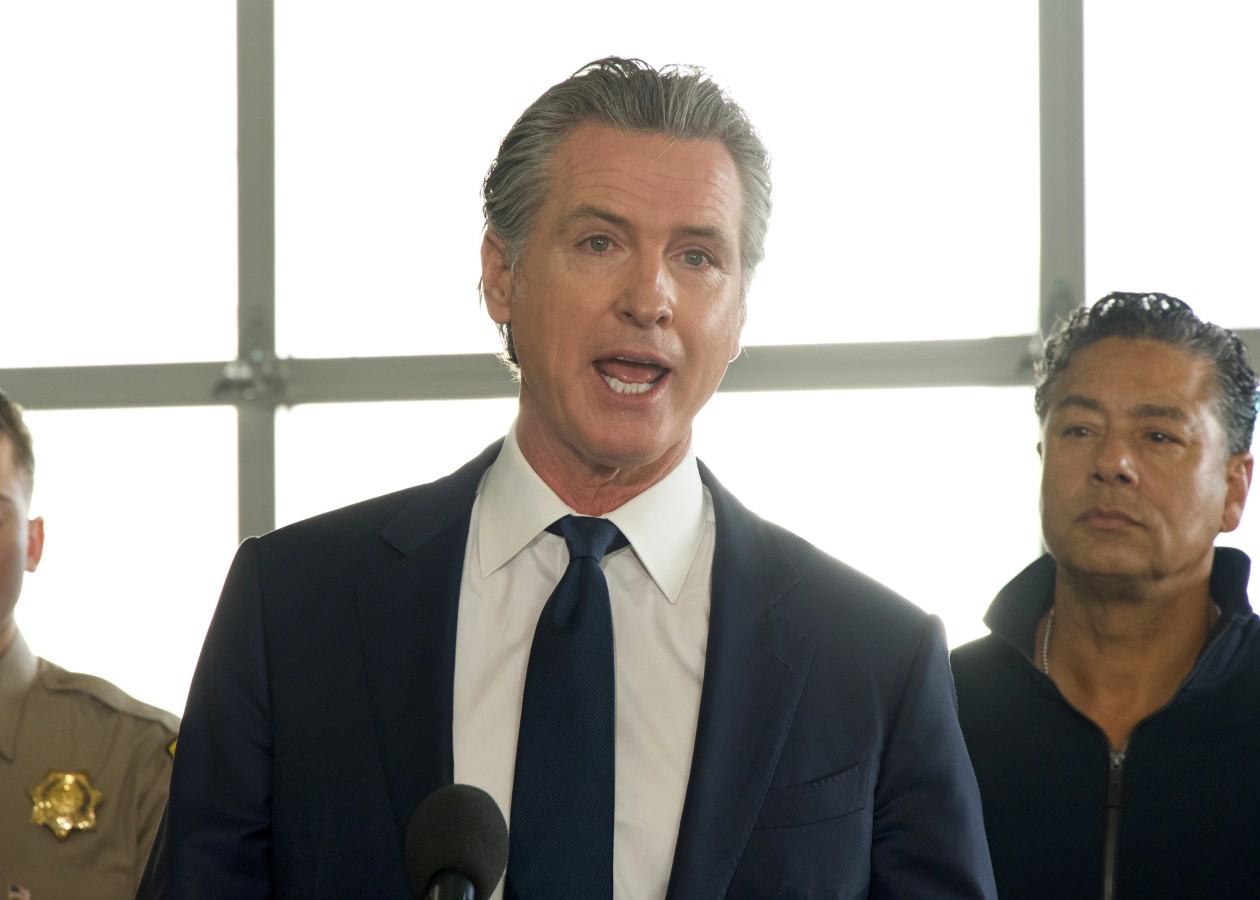
California Republicans have called on Newsom to halt the tax increase before drivers feel its impact.
Rep. David Valadao led a letter signed by members of California’s Republican congressional delegation urging the governor to suspend the scheduled increase. Among those supporting the request were James Gallagher, Tom McClintock, Vince Fong, and Young Kim.
The lawmakers argued that Californians are already paying some of the nation’s highest fuel prices while also struggling with housing, groceries, insurance, and other everyday expenses.
According to the letter, the state should prioritize lowering energy costs rather than imposing additional taxes that affect commuters, families, delivery drivers, and small businesses.
While the excise tax receives the most attention, it represents only one portion of what drivers pay each time they fill up.
Republican lawmakers estimate Californians face roughly $1.15 per gallon in combined taxes, fees, and regulatory costs. That figure includes the state excise tax, sales tax, the Low Carbon Fuel Standard, the cap-and-trade program, and the State Underground Storage Tank Program.
For someone filling a 15-gallon tank, those combined costs add approximately $17.25 to the total purchase.
Opponents argue those added charges make commuting more expensive and raise costs throughout the economy as businesses pass along higher transportation expenses to consumers.
Newsom says eliminating the tax would not guarantee lower prices
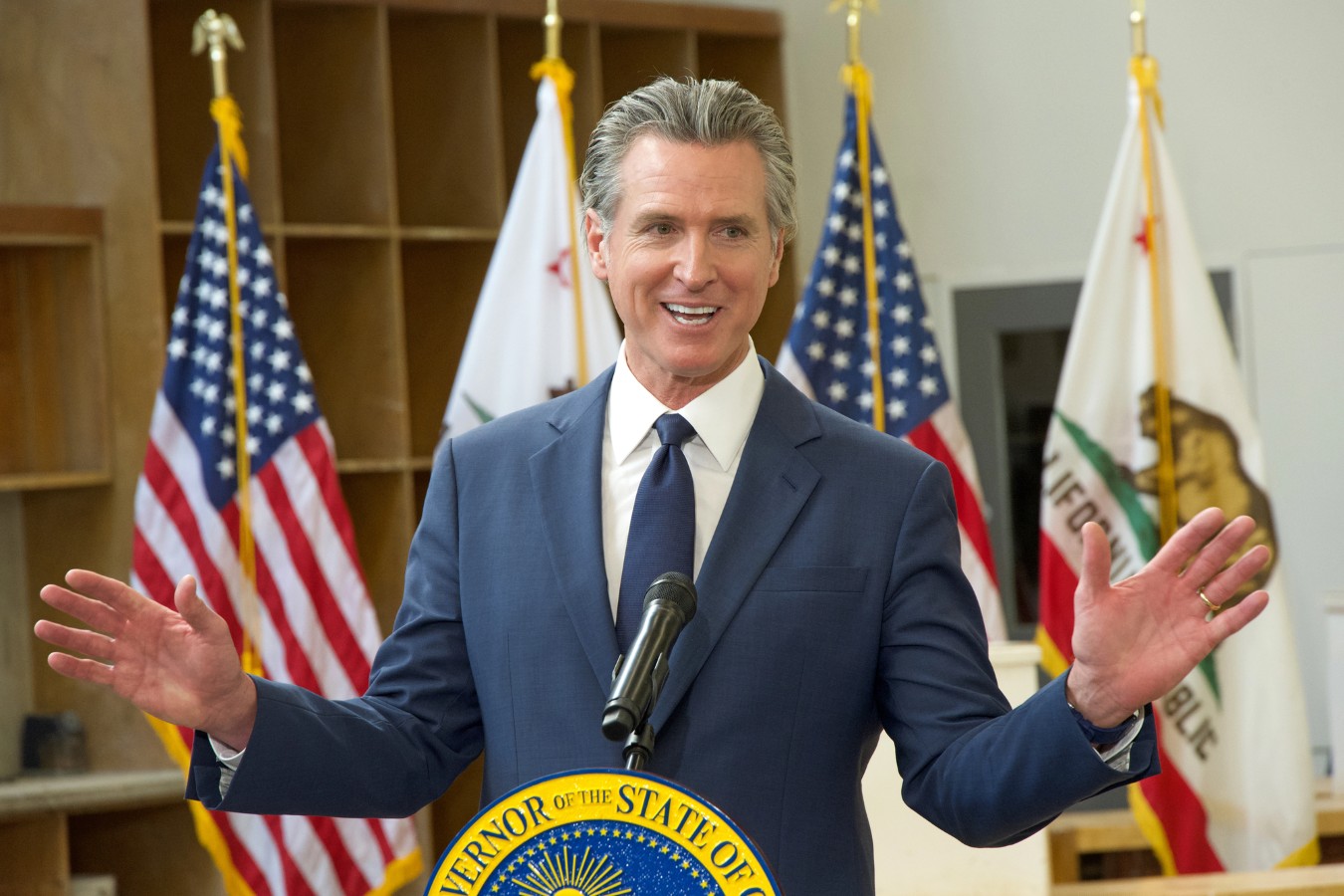
Newsom’s administration has rejected claims that suspending or eliminating the gas tax would necessarily lower prices for consumers.
In a statement released earlier this year, the governor’s office argued that repealing the tax could simply provide oil companies with a larger tax break without ensuring the savings reach drivers.
The administration has also maintained that fuel tax revenue remains critical for maintaining California’s transportation infrastructure. Officials argue road repairs, bridge improvements, and transit projects depend on the funding generated by fuel taxes.
That disagreement has become one of the central divides in California’s broader debate over energy affordability and infrastructure investment.
Today’s dispute traces back to California’s 2017 transportation funding package, which raised fuel taxes to generate billions of dollars for infrastructure improvements.
The law also established annual inflation adjustments, allowing the excise tax to increase automatically over time without requiring another vote by the Legislature.
California voters considered repealing the law during the 2018 election but rejected that effort, allowing the transportation funding system to remain in place.
Supporters point to that vote as evidence that Californians chose to continue funding road improvements, while critics argue rising living costs have changed the affordability picture since then.
California’s refinery closures could add pressure to fuel prices

The tax increase comes as California’s fuel market faces additional supply challenges.
Phillips 66 previously announced plans to cease operations at its Los Angeles-area refinery during the fourth quarter of 2025. Meanwhile, Valero said it would idle most refining process units at its Benicia refinery by April 2026 while importing additional gasoline supplies into the Bay Area.
According to the U.S. Energy Information Administration, the two facilities account for roughly 17% of California’s refining capacity.
The agency has warned that reduced in-state refining capacity could increase fuel price volatility because replacement supplies cannot easily be sourced from other U.S. refinery hubs. California’s limited pipeline connections to the rest of the country often require replacement fuel to arrive by ship, increasing both delivery times and supply risks.
California’s fuel market differs from most other states because much of the crude oil processed by its refineries comes from outside the state.
According to the California Energy Commission, California sources supplied 22.9% of the crude oil processed by the state’s refineries in 2025. Alaska accounted for another 16.0%, while foreign sources supplied the remaining 61.1%.
The U.S. Energy Information Administration has also noted that California and the broader West Coast have limited logistical connections to major refinery hubs elsewhere in the United States, including the Gulf Coast. As a result, replacement fuel supplies cannot easily be redirected from other domestic refineries and often must be imported by sea, making the state more vulnerable to supply disruptions.
Republicans argue California’s reliance on imported fuel is partly the result of state energy policies that have discouraged domestic production and refining. Democrats counter that California must continue reducing emissions while protecting air quality and public health, even as the state transitions toward cleaner energy sources.
Global events continue influencing California fuel prices
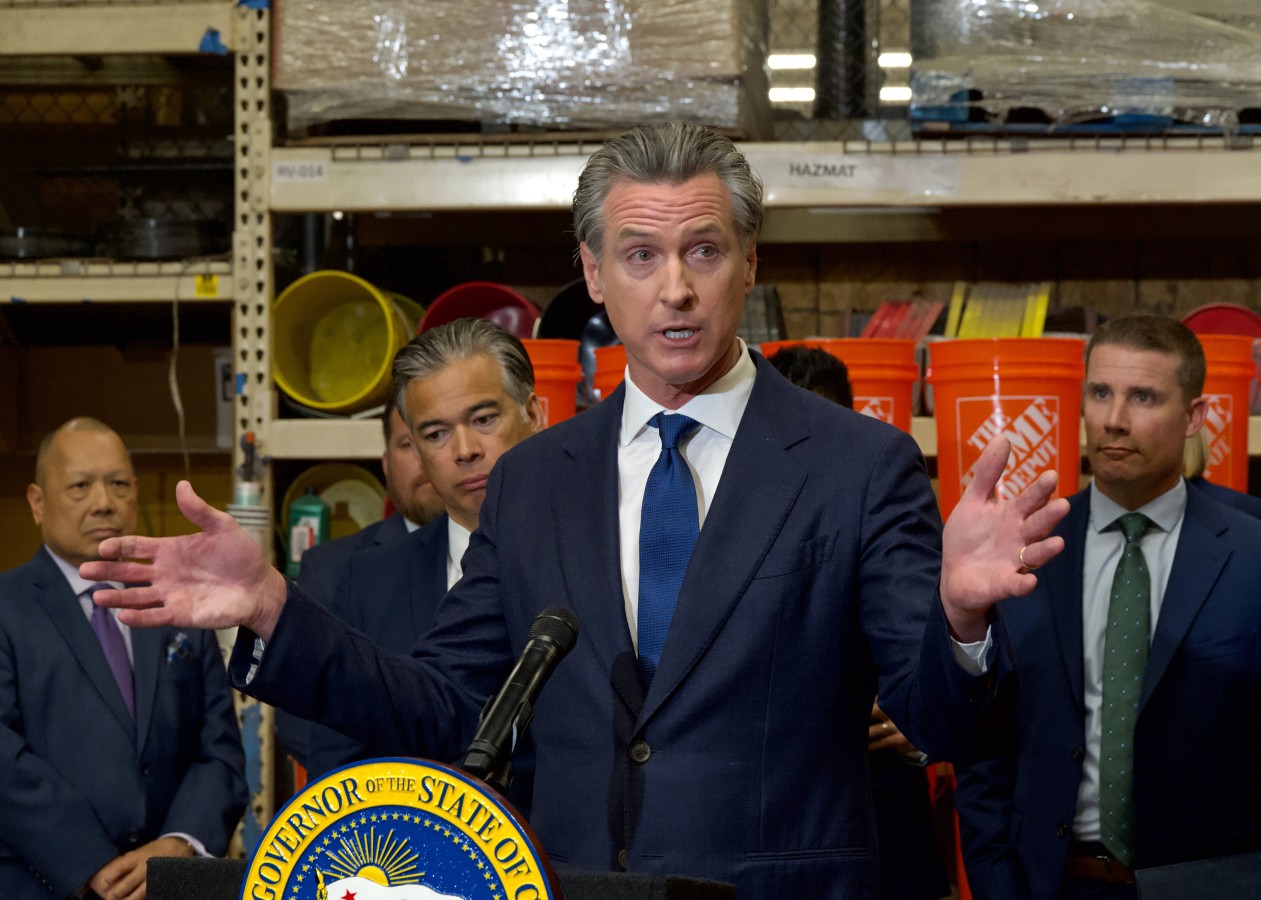
California’s dependence on imported crude means events far beyond the state’s borders can quickly affect prices at local gas stations.
According to California Energy Commission data, Iraq, Saudi Arabia, and the United Arab Emirates together supplied about 28.7% of California’s foreign crude oil imports during 2025.
The Strait of Hormuz remains one of the world’s most important energy shipping routes. The International Energy Agency estimates that roughly one-quarter of global seaborne oil trade moved through the strait during 2025, while the U.S. Energy Information Administration has estimated flows through the passage at approximately 20 million barrels of oil per day.
Newsom has argued that President Donald Trump’s conflict with Iran contributed to higher fuel costs, while Republicans contend California’s own energy policies have left the state more exposed to global disruptions. The competing explanations reflect the broader disagreement over what is driving California’s high gasoline prices.
Chevron’s headquarters move remains part of the political debate

California’s energy policies have also drawn renewed attention following Chevron’s decision to relocate its headquarters to Houston in 2024 after more than 140 years in California.
Republican critics have cited the move as evidence that the state’s regulatory climate has become increasingly difficult for major energy companies. They argue that losing investment and corporate headquarters could weaken California’s energy security while reducing jobs and tax revenue.
Supporters of California’s environmental policies see the issue differently. They argue the state’s long-term climate goals should not be altered simply to retain fossil fuel companies and maintain that reducing dependence on oil remains necessary to address climate change and improve air quality.
The relocation has become another symbol in California’s broader political debate over balancing economic competitiveness with environmental priorities.
Newsom’s long-term energy goals remain a point of contention
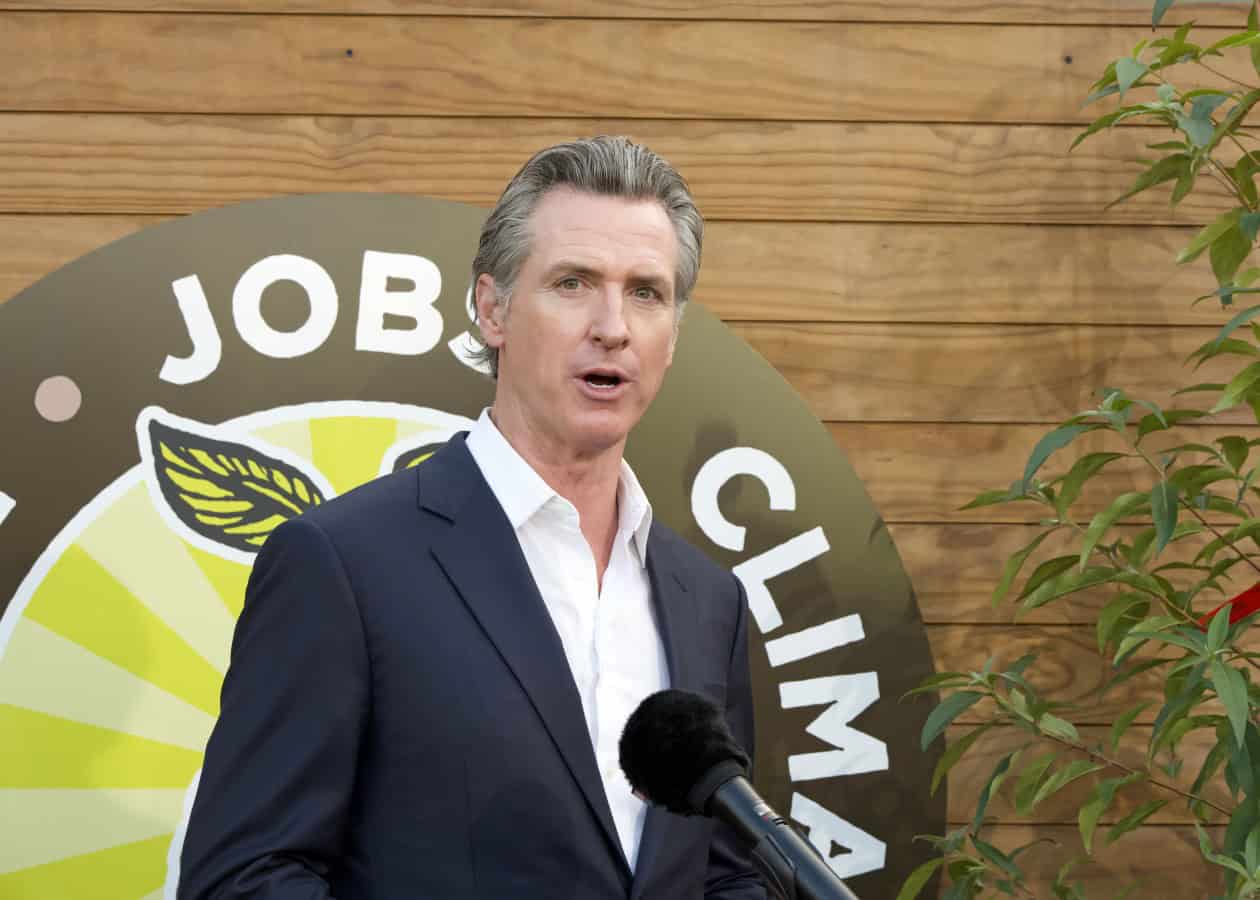
Newsom has backed a goal of ending oil extraction in California by 2045 as part of the state’s transition toward cleaner sources of energy.
Republicans argue reducing in-state oil production before affordable and reliable alternatives are fully available risks increasing fuel costs for consumers while making California more dependent on imported energy.
Supporters of the governor’s approach argue the transition is necessary to reduce greenhouse gas emissions, improve public health, and prepare California for a future with lower fossil fuel consumption.
The debate over the July 1 gas tax increase has therefore become intertwined with larger questions about California’s energy future, environmental policy, and economic competitiveness.
Newsom and Republicans clash over who is responsible for higher gas prices

The latest dispute escalated on social media as Republicans blamed Newsom’s taxes and climate policies for California’s high gasoline prices.
Rep. Vince Fong wrote on X, “55% of the cost of our gas already comes from state imposed taxes and mandates. And now, Newsom wants to raise taxes even more.”
Newsom’s Press Office responded that “The July 1 state gas tax adjustment is REQUIRED by existing state law,” adding that the increase is an “automatic, annual mechanism” enacted in 2017 and “upheld by voters in 2018,” before Newsom became governor.
The governor’s office also linked rising fuel costs to geopolitical events, writing: “The GOP-enabled Iran war has now forced a growing $63 billion in extra fuel costs on Americans nationwide — that $243.14 per California household so far this year.”
The exchange highlighted the sharply different explanations each side offers for why California drivers continue paying some of the nation’s highest fuel prices.
Critics question whether higher fuel taxes have improved roads

Beyond the immediate price increase, critics continue questioning whether California’s fuel tax revenue has delivered the transportation improvements promised when lawmakers approved the 2017 funding package.
Opponents argue that despite collecting the nation’s highest fuel-related taxes and fees, many roads remain in poor condition and maintenance projects continue facing delays. They point to bureaucracy, administrative costs, and project backlogs as reasons taxpayers have not seen a greater return on investment.
Supporters of the current funding model respond that California maintains one of the country’s largest and most heavily used transportation networks, making repairs both expensive and ongoing. They argue sustained funding is necessary to preserve aging infrastructure while supporting future transportation needs.
Another challenge facing policymakers is declining fuel tax revenue as more Californians adopt electric vehicles and increasingly fuel-efficient cars. Because those vehicles consume less gasoline; or none at all; they contribute less through traditional fuel taxes, prompting California to study alternative funding methods such as a road usage charge based on miles driven.
California’s fuel debate extends beyond one tax increase

The July 1 increase represents only 2.2 cents per gallon, but it has become the latest flashpoint in California’s larger debate over affordability, transportation funding, and energy policy.
Republicans argue that suspending the increase would provide immediate relief for households already coping with high housing costs, insurance premiums, and grocery prices. Newsom and Democratic leaders maintain that the adjustment is required under existing law and that eliminating the tax would not necessarily reduce prices while potentially jeopardizing funding for roads and transit.
For drivers, however, the immediate reality is straightforward. California continues to have some of the highest gasoline prices in the country, and even relatively small increases can add up over time for commuters, businesses, and families who rely on their vehicles every day.
As motorists fill up ahead of the Independence Day holiday, the dispute over one automatic tax adjustment has evolved into a broader political battle over taxes, infrastructure, climate policy, energy security, and California’s long-term economic future.
Like Financial Freedom Countdown content? Be sure to follow us!
11 reasons you should claim Social Security early

Deciding when to claim Social Security is often about maximizing your benefit. Financial planners usually advise delaying your claim for as long as possible to secure the highest monthly payment. Your benefit is based on your lifetime earnings, with a full payout available at your full retirement age (FRA), which is currently between 66 and 67 depending on your birth year. Claiming before FRA results in a permanent reduction in your monthly benefit, while waiting beyond FRA leads to a permanent increase. However, the decision isn’t solely about maximizing the monthly check. Personal factors such as health, family circumstances, and financial needs can play a significant role in determining the right time to claim.
11 Reasons You Should Claim Social Security Early

Did you find this article helpful? We’d love to hear your thoughts! Leave a comment with the box on the left-hand side of the screen and share your thoughts.
Also, do you want to stay up-to-date on our latest content?
1. Follow us by clicking the [+ Follow] button above,
2. Give the article a Thumbs Up on the top-left side of the screen.
3. And lastly, if you think this information would benefit your friends and family, don’t hesitate to share it with them!

John Dealbreuin came from a third world country to the US with only $1,000 not knowing anyone; guided by an immigrant dream. In 12 years, he achieved his retirement number.
He started Financial Freedom Countdown to help everyone think differently about their financial challenges and live their best lives. John resides in the San Francisco Bay Area enjoying nature trails and weight training.
Here are his recommended tools
Personal Capital: This is a free tool John uses to track his net worth on a regular basis and as a retirement planner. It also alerts him wrt hidden fees and has a budget tracker included.
Platforms like Yieldstreet provide investment options in art, legal, real estate, structured notes, venture capital, etc. They also have fixed-income portfolios spread across multiple asset classes with a single investment with low minimums of $10,000.