Trump administration says the K-shaped economy is over, but economists point to a widening divide

Treasury Secretary Scott Bessent says the U.S. economy has moved beyond the “K-shaped” recovery that has defined much of the post-pandemic period, arguing that lower-income workers are beginning to catch up with more affluent Americans.
But economists and recent government data suggest the picture remains more complicated. While layoffs have fallen to historically low levels and some lower-wage workers have benefited from wage gains, workers’ share of the nation’s economic output has dropped to its lowest level on record.
Speaking to CNBC on Tuesday, Bessent said he was “sick of hearing about this K-shaped economy.”
“I can say here definitively, the K-shaped economy is over,” Bessent continued, pointing to wage gains among lower-income workers and the expected benefits of President Donald Trump’s signature tax legislation.
Bessent said Americans would feel the effects of the tax bill “over time,” arguing that the administration’s economic agenda is helping bring lower-income households back into a stronger position.
He said the economy now looks more like a “C”—”where the lower end of wage earners are finally calling it back, just like they did in President Trump’s first term.”
What economists mean by a K-shaped economy
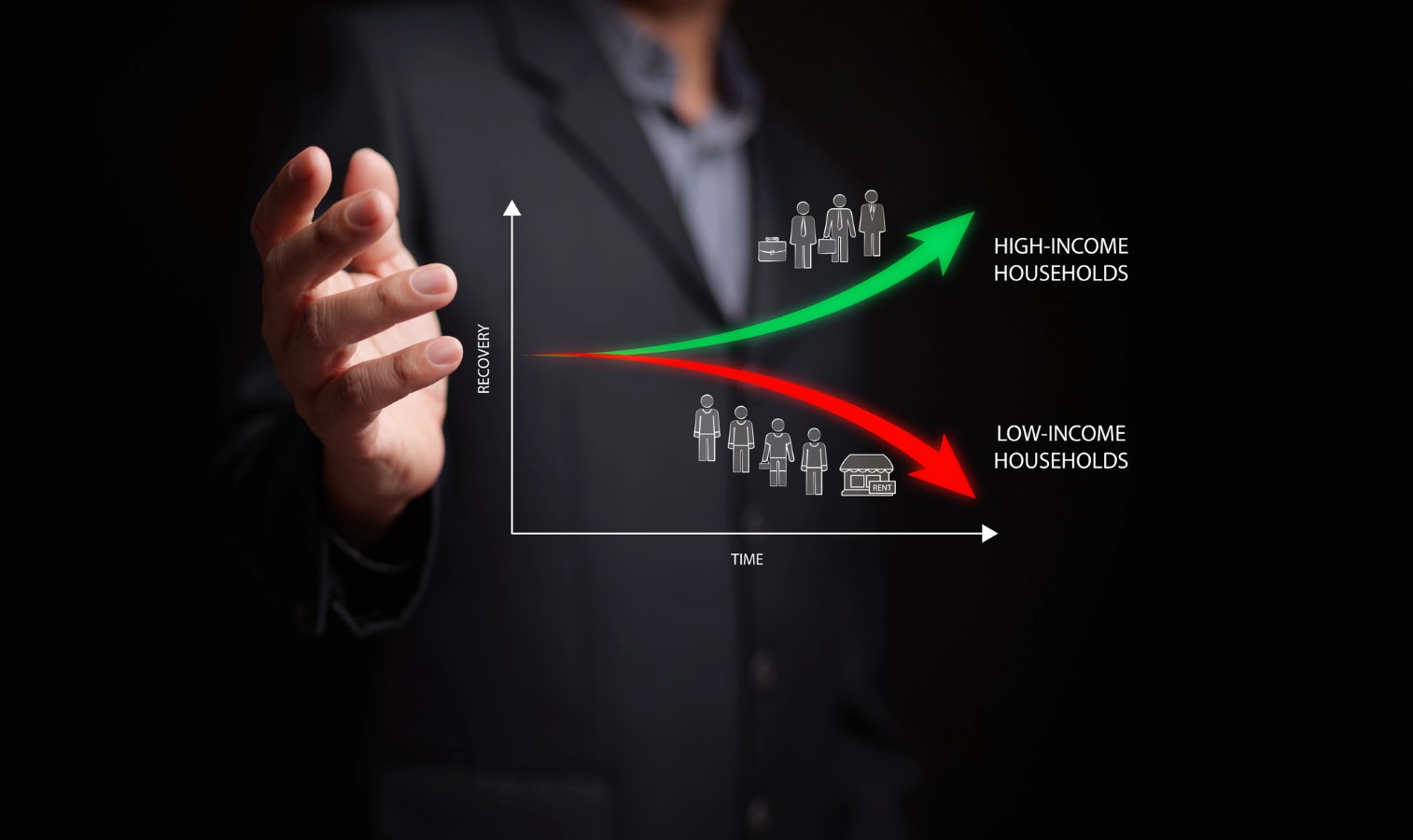
The term “K-shaped economy” describes an economy in which different groups experience sharply different economic outcomes.
The upward arm of the K represents higher-income households whose wealth, incomes and spending power continue to grow. The downward arm represents households with lower incomes that face weaker earnings growth, higher financial pressures and greater difficulty keeping up with prices.
The concept has gained attention as consumer spending and wealth have increasingly appeared to diverge between income groups.
A May report from the Federal Reserve Bank of New York found that households earning more than $125,000 a year had kept retail spending growth afloat since early 2023, while real spending among lower-income households declined for much of that period.
Wage data offer a more complicated picture

The New York Fed has also cautioned against viewing the wage picture as uniformly negative for lower-paid workers.
“Although the lowest wage quartile has experienced the lowest wage growth in the past year, we see that this has not always been the case,” the bank wrote in a separate analysis. “In fact, in some periods of 2023 and 2024, this group experienced the highest growth out of all the quartiles.”
That history helps explain why the debate over whether the economy is still K-shaped remains unsettled.
Some lower-paid workers have seen meaningful wage gains, while broader measures of purchasing power and spending continue to show significant differences between higher- and lower-income households.
Business leaders see signs of a C-shaped economy

Bessent is not alone in arguing that the economic divide may be narrowing.
Hilton CEO Christopher Nassetta made a similar observation in April after reviewing the company’s first-quarter occupancy trends. He predicted “improving performance in the lower and mid chain scales” through the remainder of 2026.
Nassetta also said revenue per available room, or RevPAR, was moving downstream from luxury properties toward a “more balanced convergence demand shape, or what I have been calling a C-shaped economy.”
The comments suggest that some businesses are seeing stronger demand from middle- and lower-income consumers after a period when affluent households drove a disproportionate share of spending.
Economists say the K-shaped divide remains

Other economists remain unconvinced that the K-shaped economy has disappeared.
In December, then-Federal Reserve Chair Jerome Powell said the phenomenon was “clearly a thing” that the central bank could observe in economic data.
“If you listen to the earnings reports for consumer-facing companies that tend to deal with low- and moderate-income people, they’ll all say that we’re seeing people tightening their belts, changing products that they buy, buying less, and that sort of thing,” he said.
Peter Orszag, CEO of financial advisory firm Lazard, also pushed back on Bessent’s assessment Tuesday.
“declaring the death of a K-shaped economy is a little bit premature,” Orszag told CNBC.
He acknowledged “encouraging signs” that the economy could be moving toward a more balanced pattern, but said weak consumer confidence was evidence that the overall picture remained “still mixed.”
Mark Zandi, chief economist at Moody’s Analytics, has taken an even stronger position.
“The K-shaped economy remains firmly intact,” Zandi posted to LinkedIn in late June.
Zandi pointed to Federal Reserve data showing a significant difference in spending between the top 20% of earners and the bottom 80%.
He argued that the spending gap made an “overwhelming case that the economy is K-shaped and becoming increasingly so.”
The conflicting assessments highlight a central question facing the U.S. economy: whether improvements in employment and wages are broad enough to overcome the persistent advantages enjoyed by higher-income households.
Layoffs are at historically low levels

The labor market does provide evidence supporting Bessent’s more optimistic assessment.
Initial jobless claims remained below 200,000 for the third consecutive week, something that had not happened since 1969.
Seasonally adjusted claims totaled 199,000, 198,000 and 189,000 over the past three weeks. A year earlier, the comparable three-week average was about 223,000.
“Layoffs remain historically low and have, if anything, declined further this year,” said Stephen Stanley, chief U.S. economist at Santander Capital Markets.
The exceptionally low number of layoffs suggests employers remain reluctant to reduce their workforces, even as hiring itself has not been particularly strong.
“These are levels indicative of a sturdy labor market,” economists Robert Kavcic and Shelly Kaushik of BMO Capital Markets wrote.
The labor market has weaknesses beneath the surface

Low layoffs do not necessarily mean that every worker is benefiting from a booming labor market.
Hiring improved during the first half of 2026, but the previous year produced the fewest new jobs in any year without a recession. ADP also reported that July’s increase in employment was the smallest in six months.
“The primary point of weakness in the labor market is that new entrants are having a hard time finding a job, especially fresh college graduates,” said Thomas Simons, U.S. economist at Jefferies.
Businesses are also navigating several sources of uncertainty, including Trump administration tariffs, the conflict in the Middle East, higher oil prices and the rapid expansion of artificial intelligence.
Those factors have contributed to caution among employers and may be limiting the pace of hiring even while companies remain reluctant to conduct layoffs.
Workers are still struggling to gain ground on inflation

The labor market’s resilience has also not translated into rapid real wage growth.
Worker pay is increasing at just over 3% annually, roughly keeping pace with inflation. Real weekly earnings, which account for changes in consumer prices, were essentially unchanged during the first half of 2026.
June provided a more encouraging reading, with real weekly earnings posting their strongest result in six years after three consecutive monthly declines.
Still, the broader trend suggests that workers have not yet seen a decisive improvement in purchasing power.
“The upshot is that despite potential signs of a pickup in employment growth, the labor market won’t be a source of inflationary pressure this year,” said Matthew Martin, an economist at Oxford Economics.

Perhaps the strongest evidence against declaring the K-shaped economy dead comes from the latest data on labor’s share of economic output.
The Bureau of Labor Statistics reported that workers’ share of nominal GDP fell to 52.9% in the second quarter from 53.7% in the first quarter.
That was the lowest level since the BLS series began in 1947.
The decline came even as productivity increased, highlighting the growing gap between how much the economy produces and how much of that output is captured through worker compensation.
The long-term decline in labor’s share has been linked to several forces, including weaker union representation, globalization and the shift of manufacturing production to lower-cost countries.
More recently, automation and artificial intelligence have allowed companies to increase production without necessarily expanding their workforces at the same rate.
The economy may be improving without becoming more equal
The competing evidence points to an economy that can simultaneously show signs of strength and persistent inequality.
Historically low layoffs indicate that workers who already have jobs may have substantial protection from job losses. Some lower-wage workers have also experienced periods of faster wage growth.
At the same time, higher-income households continue to account for a disproportionate amount of consumer spending, while new entrants face a difficult hiring environment and workers’ overall share of GDP has fallen to a record low.
That makes the disagreement over the “K-shaped” economy less about whether the economy is growing and more about who is benefiting from that growth.
For the Trump administration, improving wages and low layoffs are evidence that the economic divide is narrowing. For economists who continue to use the K-shaped description, the spending gap, weak real wage growth and declining labor share indicate that the benefits of economic expansion remain unevenly distributed.
Whether the economy ultimately takes the shape of a “C” or remains a “K” may therefore depend on whether wage growth, employment and consumer spending continue broadening beyond the nation’s highest-income households.
Like Financial Freedom Countdown content? Be sure to follow us!
11 reasons you should claim Social Security early

Deciding when to claim Social Security is often about maximizing your benefit. Financial planners usually advise delaying your claim for as long as possible to secure the highest monthly payment. Your benefit is based on your lifetime earnings, with a full payout available at your full retirement age (FRA), which is currently between 66 and 67 depending on your birth year. Claiming before FRA results in a permanent reduction in your monthly benefit, while waiting beyond FRA leads to a permanent increase. However, the decision isn’t solely about maximizing the monthly check. Personal factors such as health, family circumstances, and financial needs can play a significant role in determining the right time to claim.
11 Reasons You Should Claim Social Security Early

Did you find this article helpful? We’d love to hear your thoughts! Leave a comment with the box on the left-hand side of the screen and share your thoughts.
Also, do you want to stay up-to-date on our latest content?
1. Follow us by clicking the [+ Follow] button above,
2. Give the article a Thumbs Up on the top-left side of the screen.
3. And lastly, if you think this information would benefit your friends and family, don’t hesitate to share it with them!

John Dealbreuin came from a third world country to the US with only $1,000 not knowing anyone; guided by an immigrant dream. In 12 years, he achieved his retirement number.
He started Financial Freedom Countdown to help everyone think differently about their financial challenges and live their best lives. John resides in the San Francisco Bay Area enjoying nature trails and weight training.
Here are his recommended tools
Personal Capital: This is a free tool John uses to track his net worth on a regular basis and as a retirement planner. It also alerts him wrt hidden fees and has a budget tracker included.
Platforms like Yieldstreet provide investment options in art, legal, real estate, structured notes, venture capital, etc. They also have fixed-income portfolios spread across multiple asset classes with a single investment with low minimums of $10,000.