America’s middle class shrinks as millions move up the income ladder but still feel squeezed

The common narrative of a disappearing American middle class often suggests a slide into poverty. However, recent data from the nonpartisan American Enterprise Institute (AEI) reveals a different reality: Americans are not falling behind; they are moving up. While the “core” middle class is indeed shrinking, it is primarily because households are ascending into the upper-middle class. Since 1979, this group has tripled in size, becoming the most populous economic group in the United States.
The middle class shrinks for an unexpected reason

The shrinking of the traditional middle class is often framed as a sign of economic distress, but the AEI analysis suggests a different story. Instead of falling behind, many households have moved up the income ladder into higher brackets. As a result, fewer Americans remain within the “core” middle-income range, not because they are poorer, but because they are earning more.
“It is simply inaccurate to characterize the ‘shrinking’ middle class as reflecting diminished economic security rather than material progress,” Rose and Winship wrote.
The share of U.S. households considered upper-middle class has undergone a massive transformation. In 1979, only about 10.4% of families fell into this category. By 2024, that figure jumped to 31.1%. This shift has fundamentally altered the American economic landscape, moving from a distribution where the middle was the largest group to one where the affluent upper tier now leads. This growth suggests that the economy has been remarkably effective at fostering upward mobility over the last 45 years.
Income gains drive long-term economic mobility

The findings are based on U.S. Census data tracking family incomes from 1979 through 2024. Over that period, inflation-adjusted incomes rose substantially across the distribution. Median family income increased by about 52%, while even households at the 10th percentile saw gains of roughly 30%, underscoring broad-based economic progress.
“The whole distribution of Americans, from poor to rich, has done better over time. And to the extent that fewer people are within a fixed income range that we might think of as middle class, that’s just because everybody’s gotten richer over time,” Scott Winship said.
AEI defines the upper middle class as households earning between $153,864 and $461,592 for a family of four. Under this framework, the upper middle class now represents the single largest economic segment in the country. Meanwhile, the share of households classified as “rich” has also grown, reaching 3.7%; about 12 times higher than in 1979.
Breaking down the 2024 income brackets

To track these shifts, researchers categorized households based on multiples of the federal poverty guideline. For a family of four in 2024, the tiers are defined by the following annual income ranges:
Rich: Households earning over $461,592.
Upper-middle class: Households earning between $153,864 and $461,592.
Core middle class: Households earning between $76,932 and $153,864.
Lower-middle class: Households earning between $38,466 and $76,932.
Poor or near poor: Households earning below $38,466.
For a single individual, the threshold to enter the upper-middle class begins at approximately $76,932.
When comparing the economic landscape of 1979 to that of 2024, the data shows a clear migration toward higher income tiers.
The “rich” category grew from 0.3% to 3.7%, while the “upper-middle class” surged from 10.4% to 31.1%.
Conversely, every other category saw a decline in its share of the population. The “core middle class” dropped from 35.5% to 30.8%, the “lower-middle class” fell from 24.1% to 15.8%, and the “poor or near poor” category decreased from 29.7% to 18.7%.
Geographic costs complicate income classifications

Despite these gains, income alone does not fully capture economic reality. Geographic differences in cost of living significantly affect how far a salary goes. For example, households in high-cost areas such as New York City or San Francisco may require far higher incomes to achieve the same standard of living as those in less expensive regions.
One estimate found that an individual in parts of Manhattan needs at least $95,000 annually just to meet basic living costs; well above the national threshold for entering the upper middle class.
Dual incomes and women’s education fuel growth

A major driver of rising household income has been the increase in dual-earner families, particularly due to gains in women’s education and workforce participation. In 1970, only about 11% of women held college degrees; today, that figure is closer to 40%.
“The additional opportunities that women have are a big part of the story,” Winship said. “People have chosen to work more and afford more things, rather than, say, have more children or have a sort of traditional sole breadwinner, but then have less money to buy things.”
Why Americans still feel financially strained

Despite measurable income gains, many Americans report feeling financially stretched. Surveys show widespread concern about affordability, particularly when it comes to housing, education, and raising a family.
Winship points to a disconnect between perception and reality. “When you ask people about their own families, their own personal financial situation, you get much, much larger shares of people who say that they’re doing fairly well,” he said.
One explanation for this disconnect is that certain essential costs; especially housing, healthcare, and education; have risen much faster than inflation. These “big-ticket” expenses dominate household budgets and shape perceptions of financial wellbeing, even as other goods and services have become more affordable over time.
“There’s a tendency to focus on the sort of three or four big-ticket items that have gotten a lot more expensive without realizing that that’s only part of what people spend their money on, and a lot of things have gotten cheaper over time,” Winship said.
Wealth versus income reveals a deeper divide
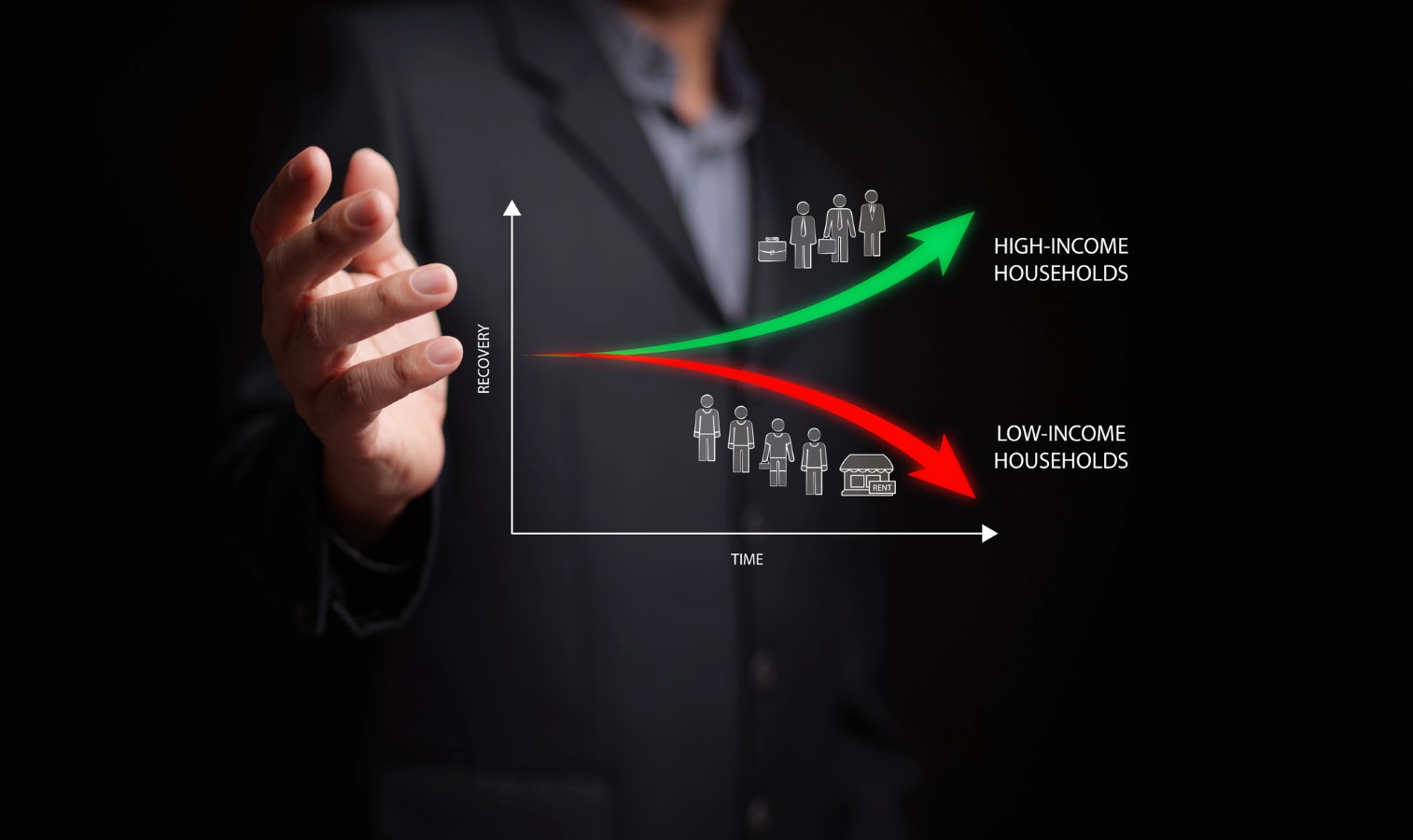
While the AEI report focuses on income, critics argue that wealth provides a more complete picture of economic security. A growing number of Americans now fall into affluent wealth brackets, yet many still feel financially insecure due to debt, housing costs, and competition for limited high-end resources.
As more households achieve higher incomes, they increasingly compete for the same desirable neighborhoods, schools, and lifestyles; driving up prices and reinforcing a sense of scarcity.
The role of perception in a hyper-connected world

Another factor shaping financial anxiety is the modern media environment. Social media and digital platforms expose households to the lifestyles of the ultra-wealthy, shifting perceptions of what constitutes success. What would have once been considered affluent now feels ordinary when compared to curated images of extreme wealth.
This constant comparison creates a psychological gap between objective prosperity and subjective experience, making even high earners feel behind.
A century of progress meets modern disruption

Viewed over a longer timeline, the data aligns with a broader story of economic progress. Global GDP has expanded dramatically over the past century, and living standards have improved across much of the world. However, recent decades have also brought slower productivity growth and structural changes that have reshaped how prosperity is distributed.
The result is a paradox: widespread economic gains alongside persistent feelings of instability and competition.
The central takeaway from the AEI report is that the American middle class has not disappeared; it has evolved. More households are wealthier than ever before, but that success has introduced new challenges, from rising expectations to intensified competition for status and resources.
In today’s economy, prosperity is more common; but also more crowded. As more Americans climb the economic ladder, they find themselves sharing the same space, redefining what it means to be “middle class” in a nation that has grown richer, yet more uncertain about how that wealth is experienced.
Like Financial Freedom Countdown content? Be sure to follow us!
14 essential strategies to maximize your Social Security and avoid costly mistakes

Social Security is a vital lifeline for many seniors, providing crucial income support during retirement. With inflation at its highest in four decades, Social Security’s inflation-adjusted benefits offer protection against rising costs.
Rising interest rates have disrupted many retirement portfolios, causing bond fund values to plummet. In this volatile financial landscape, Social Security can stabilize a typical stock-bond retirement portfolio. By implementing smart strategies, retirees can maximize their Social Security benefits and ensure a more secure financial future.
14 Essential Strategies to Maximize Your Social Security and Avoid Costly Mistakes
11 reasons you should claim Social Security early

Deciding when to claim Social Security is often about maximizing your benefit. Financial planners usually advise delaying your claim for as long as possible to secure the highest monthly payment. Your benefit is based on your lifetime earnings, with a full payout available at your full retirement age (FRA), which is currently between 66 and 67 depending on your birth year. Claiming before FRA results in a permanent reduction in your monthly benefit, while waiting beyond FRA leads to a permanent increase. However, the decision isn’t solely about maximizing the monthly check. Personal factors such as health, family circumstances, and financial needs can play a significant role in determining the right time to claim.
11 Reasons You Should Claim Social Security Early
Did you find this article helpful? We’d love to hear your thoughts! Leave a comment with the box on the left-hand side of the screen and share your thoughts.
Also, do you want to stay up-to-date on our latest content?
1. Follow us by clicking the [+ Follow] button above,
2. Give the article a Thumbs Up on the top-left side of the screen.
3. And lastly, if you think this information would benefit your friends and family, don’t hesitate to share it with them!

John Dealbreuin came from a third world country to the US with only $1,000 not knowing anyone; guided by an immigrant dream. In 12 years, he achieved his retirement number.
He started Financial Freedom Countdown to help everyone think differently about their financial challenges and live their best lives. John resides in the San Francisco Bay Area enjoying nature trails and weight training.
Here are his recommended tools
Personal Capital: This is a free tool John uses to track his net worth on a regular basis and as a retirement planner. It also alerts him wrt hidden fees and has a budget tracker included.
Platforms like Yieldstreet provide investment options in art, legal, real estate, structured notes, venture capital, etc. They also have fixed-income portfolios spread across multiple asset classes with a single investment with low minimums of $10,000.