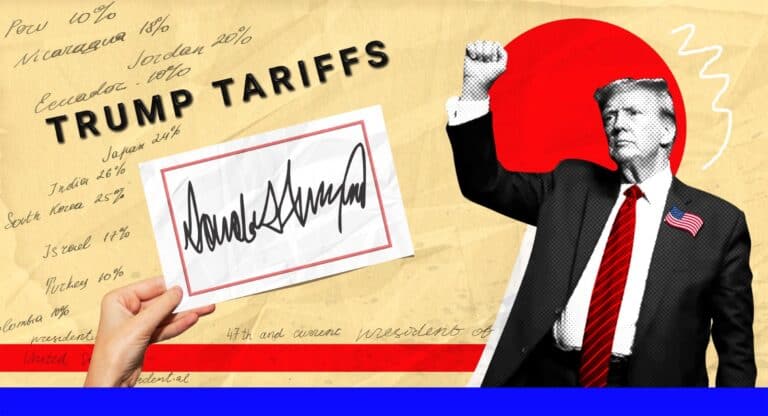
Trump touts the ‘best economy ever’ but poll data shows surprising cracks within his own base

President Donald Trump is actively touting the U.S. economy as the strongest in the nation’s history. While certain economic indicators heavily support his optimism, a broader look at the core data paints a far more complicated, uneven, and deeply partisan picture for everyday Americans.
In a Truth Social post on Sunday, Trump declared that America was “winning like never before,” citing strong job growth and stock market performance. While the labor market and equities have exceeded expectations in recent months, inflation remains elevated, and many Americans continue to express deep concerns about their financial outlook. This division highlights a stark split between macro-level market metrics and the micro-level realities of household budgets.
Even before firmer signs emerged that the U.S. and Iran were prepared to sign a deal to bring an over-three-month conflict to a close, many observers remarked on the “resilience” shown by the economy in the face of critical supply chain pressures and higher inflation.
Yet the disconnect between headline economic data and public sentiment remains striking. While investors have benefited from a booming stock market and employers continue to add jobs, many households say they are still struggling with the cost of living.
Economist describe the economy as solid but uneven: job growth is resilient, the stock market is strong but concentrated, and inflation is lower than at its peak but still too high to declare victory.
Why a resilient job market is falling short of historic records

Trump did not clarify what he meant by “record job numbers.” In absolute terms, employment is at an all-time high, with roughly 159 million Americans employed as of May. However, normal population growth means employment totals tend to naturally rise over time. While not approaching truly historic or “record” levels, job gains have blown past expectations in recent months, even as some feared the labor market could prove another casualty of the geopolitical conflict.
The economy added 172,000 jobs in May, more than double analysts’ expectations and marking the third consecutive month of stronger-than-forecast job growth. At the same time, the unemployment rate held steady at 4.3 percent. While this is slightly higher than the 4 percent rate recorded at the start of Trump’s second term, it has improved from a recent peak of 4.5 percent last November.
The numbers indicate a healthy labor-market reading, but it is not a record number and not unusual by historical standards. Overall, the economy has added an average of 114,000 jobs per month in 2026, which marks a significant improvement from the first five months of 2025. Even so, current job growth remains below the pace seen during much of the post-pandemic recovery and trails some stronger years earlier in the decade.
Technology sector is masking broader stock market volatility

American equities continue to outperform their global peers, with all major indexes rallying to record or near-record highs on the back of an artificial intelligence investment boom. On the stock market, President Trump has a stronger factual basis. Major equity indexes have recently been at or close to record highs. But stock-market performance is also highly volatile and not the same as the state of the overall economy.
A number of planned blockbuster listings are expected to provide a further lift to equities. This wave was kicked off by SpaceX’s record-setting IPO on June 12, which priced its shares at $135 and successfully raised $75 billion.
According to financial analysis, the blockbuster debut immediately vaulted the aerospace and communications giant into a $2+ trillion valuation, making Elon Musk the world’s first trillionaire and signaling massive capital concentration within the tech sector.
Extreme market concentration creates warning signs

Rising equity prices have coincided with growing concern about high levels of market concentration, with a smaller number of AI-forward tech giants now driving many of the gains. This has created what some view as a “bubble” that could precede a sharp correction or crash. As a share of the S&P 500’s total market capitalization, “Magnificent Seven” stocks now account for around 35 percent, up from 23 percent five years ago.
“This combination of elevated concentration and narrow market leadership poses a range of risks for investors, including greater sensitivity to earnings disappointment and the increased probability of a disorderly market correction,” Goldman Sachs researchers wrote in a recent report.
Persistent inflation continue to squeeze household budgets

While progress in the Iran talks has seen gas prices fall over the past few weeks, American drivers are still paying significantly more per gallon than before the conflict. The spike in fuel costs has helped push economywide inflation to 4.2 percent per the Department of Labor’s latest reading, marking its fastest annual pace since April 2023.
Trump welcomed the figures—“I love the inflation“—arguing these numbers would lead to an even more satisfying drop once the conflict officially ended. However, many political analysts see rising prices as a key vulnerability for the president’s party in this year’s elections, as well as a critical strain on already-struggling households. This resurgent inflation has also created a tight bind for the newly appointed, pro-easing Federal Reserve chair, who explicitly noted after leaving interest rates unchanged that “persistently high prices are a burden for the American people.”
Voters reject the boom narrative in latest national polls

Despite improving economic data in several macro areas, public opinion remains overwhelmingly negative. A June 17 to 19 poll of 2,519 adults conducted by CBS News found that only 34 percent of Americans approve of the way Trump is handling the economy, compared to 66 percent who disapprove. On inflation specifically, his support has sunk to 27 percent, with 73 percent doubting his ability to rein in rising prices.
The latest NPR/PBS News/Marist poll similarly showed that only 33 percent approve of Trump’s economic stewardship; his lowest rating across both terms and 3 points under former President Joe Biden’s lowest point.
When evaluating why public perception remains so sour despite high stock values, cross-tab data reveals deep partisan fragmentation alongside unexpected internal cracks within political bases.
Data from the NPR/PBS News/Marist Poll indicates that while the low 33 percent approval floor is heavily weighed down by Democrats and independents; with 64 percent of independents disapproving of Trump’s presidency overall and 65 percent disapproving of his economic stewardship; a notable 22 percent of self-identified Republicans now express explicit disapproval of the president’s economic performance.
This internal base friction is further backed by detailed reporting from CBS News, which details a substantial 23-percentage-point delta between how Republicans grade the administration on separate core issues. While Trump maintains an 89 percent approval rating among Republicans for immigration and an 85 percent overall party approval rating, his positive marks for handling inflation have deteriorated to 63 percent within his own party.
The one-third of Republicans who give him negative marks on the cost of living note they feel “frustrated” rather than “angry,” yet their shifting sentiment marks a significant shift in core support.
Consumer sentiment surveys show a rare moment of bipartisan economic anxiety

Historically, consumer confidence indexes display a massive “partisan tilt,” where sentiment measures automatically skyrocket among members of the sitting president’s party and collapse among the opposition. However, current trends show an anomaly. According to tracking data from the University of Michigan Surveys of Consumers, the Consumer Sentiment Index hovered at a bleak 48.9 for June. While this represented a modest 9 percent bump from May’s historic floor due to a temporary dip in gas prices, sentiment metrics remain roughly 19 percent lower than the same period last year.
Analyses compiled by market tracking data from Advisor Perspectives reveal that the current economic slump represents a rare moment of bipartisan agreement. Rather than fracturing strictly along ideological party lines, sentiment drops have hit consistently across the entire political spectrum. Because elevated energy costs, food costs, and stubborn “kitchen table issues” target all households indiscriminately, the financial pressure has overridden partisan leniency.
President Trump blames oil companies

In a late night post yesterday on X, President Trump said, “The big Oil Companies are not dropping their price at the pump commensurate with the sharply lower prices they are paying for Oil. Those prices are dropping like a rock! In other words, customers are being “gouged.” I have instructed the DOJ to immediately start looking into this. Gasoline prices better start going down a lot faster than what I’m seeing! President DJT”
Economic issues could shape the midterms
Ultimately, the data indicates that until structural inflation drops, voters across all political demographics remain deeply unconvinced by claims of an unprecedented historic boom. The ongoing economic dissonance presents a unique challenge for the administration moving into the upcoming election cycle.
While a booming stock market and localized tech surges like the SpaceX public debut offer strong talking points for political speeches, they do little to alleviate the day-to-day pressures of a 4.2 percent annual inflation rate.
Because financial strain is cutting across traditional party boundaries; as evidenced by the slide in inflation approval among the president’s own base; the upcoming electoral landscape will likely be decided by consumer realities rather than political rhetoric.
For the average voter, an economy can only truly be called the best ever when it finally starts feeling like it at the grocery checkout line. With only a few months before the midterms, President Trump has to convince the voters that inflation has been tamed.
Like Financial Freedom Countdown content? Be sure to follow us!
14 essential strategies to maximize your Social Security and avoid costly mistakes

Social Security is a vital lifeline for many seniors, providing crucial income support during retirement. With inflation at its highest in four decades, Social Security’s inflation-adjusted benefits offer protection against rising costs.
Rising interest rates have disrupted many retirement portfolios, causing bond fund values to plummet. In this volatile financial landscape, Social Security can stabilize a typical stock-bond retirement portfolio. By implementing smart strategies, retirees can maximize their Social Security benefits and ensure a more secure financial future.
14 Essential Strategies to Maximize Your Social Security and Avoid Costly Mistakes
11 reasons you should claim Social Security early

Deciding when to claim Social Security is often about maximizing your benefit. Financial planners usually advise delaying your claim for as long as possible to secure the highest monthly payment. Your benefit is based on your lifetime earnings, with a full payout available at your full retirement age (FRA), which is currently between 66 and 67 depending on your birth year. Claiming before FRA results in a permanent reduction in your monthly benefit, while waiting beyond FRA leads to a permanent increase. However, the decision isn’t solely about maximizing the monthly check. Personal factors such as health, family circumstances, and financial needs can play a significant role in determining the right time to claim.
11 Reasons You Should Claim Social Security Early
Did you find this article helpful? We’d love to hear your thoughts! Leave a comment with the box on the left-hand side of the screen and share your thoughts.
Also, do you want to stay up-to-date on our latest content?
1. Follow us by clicking the [+ Follow] button above,
2. Give the article a Thumbs Up on the top-left side of the screen.
3. And lastly, if you think this information would benefit your friends and family, don’t hesitate to share it with them!

John Dealbreuin came from a third world country to the US with only $1,000 not knowing anyone; guided by an immigrant dream. In 12 years, he achieved his retirement number.
He started Financial Freedom Countdown to help everyone think differently about their financial challenges and live their best lives. John resides in the San Francisco Bay Area enjoying nature trails and weight training.
Here are his recommended tools
Personal Capital: This is a free tool John uses to track his net worth on a regular basis and as a retirement planner. It also alerts him wrt hidden fees and has a budget tracker included.
Platforms like Yieldstreet provide investment options in art, legal, real estate, structured notes, venture capital, etc. They also have fixed-income portfolios spread across multiple asset classes with a single investment with low minimums of $10,000.